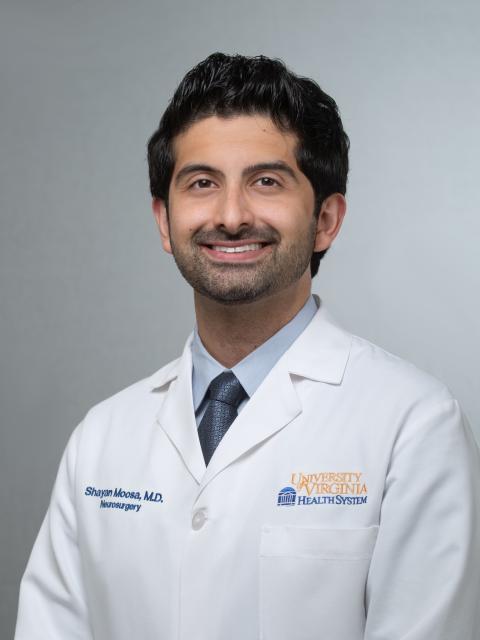
Shayan Moosa, MD
Neurosurgery - Cranial
Additional Locations
Bio & Overview
Shayan Moosa, MD, is a neurosurgeon at UVA Health who specializes in stereotactic and functional neurosurgery and minimally invasive treatment of brain tumors.
He cares for people with:
- Movement disorders
- Epilepsy
- Chronic pain
- Spasticity
- Brain tumors
- Peripheral nerve conditions
Dr. Moosa approaches each patient’s care with the attention he would want for a member of his own family. He takes time to understand how a condition affects daily life, explain treatment options, and discuss potential benefits and risks. His goal is to recommend the least invasive approach that is appropriate for each patient’s condition and goals.
He uses frame-based and robot-assisted techniques for stereotactic surgery, supported by advanced imaging, artificial intelligence (AI)-based targeting, and tractography to map brain pathways and guide treatment planning.
For movement disorders, he offers deep brain stimulation (DBS), incision-free MRI-guided focused ultrasound, and radiofrequency (RF) ablation for tremor.
His epilepsy practice includes stereo-EEG to identify where seizures begin, surgery to remove or disconnect seizure-producing areas, and implanted devices, including DBS, responsive neurostimulation (RNS), and vagus nerve stimulation (VNS).
He also performs brain tumor surgery and MRI-guided laser interstitial thermal therapy (LITT), also called laser ablation, for selected brain tumors and epilepsy.
Dr. Moosa’s pain practice includes microvascular decompression and rhizotomy for trigeminal neuralgia, occipital nerve decompression, dorsal root ganglionectomy, and neurectomy. He offers spinal cord, peripheral nerve, and motor cortex stimulation, including peripheral nerve stimulation (PNS) for facial pain and occipital neuralgia. Other options include implanted medication pumps for pain or spasticity and procedures that interrupt specific pain pathways for severe, treatment-resistant pain.
His peripheral nerve practice includes nerve decompression, repair and transfers, brachial plexus surgery, and removal of nerve tumors and painful neuromas. He also performs diagnostic nerve and muscle biopsies.
Dr. Moosa’s research explores focused ultrasound for neuromodulation (changing activity in brain circuits), blood-brain barrier opening, drug delivery, and sonodynamic therapy for cancer (which combines ultrasound with a medication to investigate a new way of targeting tumor cells).
He leads clinical trials of sonodynamic therapy for recurrent glioblastoma, a form of brain cancer that has returned, and low-intensity focused ultrasound for essential tremor. He also investigates how AI-assisted targeting can improve the precision of deep brain stimulation and focused ultrasound treatments for movement disorders. In addition, he serves as an investigator in a clinical trial of neuronal cell therapy for drug-resistant temporal lobe epilepsy and has performed stereotactic procedures to deliver this investigational treatment.
Dr. Moosa earned his undergraduate degree in neuroscience and his medical degree at UVA, where he also completed his neurosurgical residency. He pursued specialized training in stereotactic and functional neurosurgery with Jeff Elias, MD, at UVA and spent a year training at Auckland City Hospital in New Zealand.
He is the outpatient medical director, neurosurgery clerkship director, associate residency program director, and associate director of the Stereotactic & Functional Fellowship in the Department of Neurosurgery.
Dr. Moosa is the author or coauthor of more than 60 scientific publications and book chapters. His honors include the Early Career Clinical Investigator Award from the International Society for Therapeutic Ultrasound (2026), the Faculty Mentorship and Teaching Award from the UVA Department of Neurosurgery (2026), and the Excellence in Patient Experience Award (2024 and 2025).
Academic Information
- Department
- Neurosurgery
- Academic Role
- Assistant Professor
- Division
- Neurosurgery-Cranial
Conditions & Treatments
- Carpal tunnel syndrome surgery
- Deep brain stimulation
- Deep brain stimulation (asleep)
- Deep brain stimulation (awake)
- Deep brain stimulation for dystonia
- Epilepsy surgery
- Epilepsy surgery evaluation
- Essential tremor
- Focused ultrasound
- Movement disorders
- Parkinson's disease (pd) surgery
- Peripheral nerve surgery
- Rhizotomy surgery of trigeminal nerve pain
- Spinal cord stimulator
- Thalamotomy
- Trigeminal neuralgia
- Gender
- Male
- Languages
- English
- Age Groups Seen
- Adults (21-65)
Older Adults (65+)
- Primary Education
- University of Virginia School of Medicine (2015)
- Residency
- UVA Health Medical Center (2022)
- Additional Specialties
- Neurosurgery
Highlights
Meet Shayan Moosa, MD
I'm Dr. Shayan Moosa, and I'm a neurosurgeon at the University of Virginia. I see a wide variety of patients, including those with movement disorders, spasticity, epilepsy, chronic pain, and peripheral nerve lesions. My expertise is in stereotactic and functional neurosurgery, as well as pain and peripheral nerve disorders. My desire to go into neurosurgery really progressed when I was a medical student. At that time, I was able to see how devastating neurological diseases can be for patients, but at the same time, I could also see how much of a profound impact neurosurgeons could have on their patients, and that's what really made me decide to become a neurosurgeon. I think what new patients can expect is that I treat all of my patients as if they're my own family members. That's a philosophy that I have, so you can expect that I would devote a hundred percent of my time and attention, both in the clinic and the operating room, to make sure that we achieve the best result possible. What really gives me the most satisfaction is seeing a patient return back to their normal neurologic baseline. For example, we treat patients with essential tremor, and these are patients who have difficulty in basic tasks such as feeding themselves or dressing themselves. And by using deep brain stimulation technology or focused ultrasound technology, we can almost instantaneously return their function back to normal. I truly believe UVA is the best place for patients to receive their healthcare, not only because we have excellent healthcare providers here, but because we really strive to stay on the forefront of medical advancements, and I truly think that that is extremely important in our rapidly changing world.
Reviews
166 Patient Satisfaction Ratings
Our patient satisfaction ratings are an average of all the survey responses to the below questions a provider got within the past 2 years. To protect your privacy, patients aren't identified.
See more about our patient satisfaction surveys .