MR-Linac: Advanced Radiation Therapy for Cancer Treatment
Make an Appointment
Radiation therapy is a powerful way to kill cancer cells. But it can also harm healthy tissue. At UVA Health, you’ll find the latest advance in radiation therapy — MR-linac.
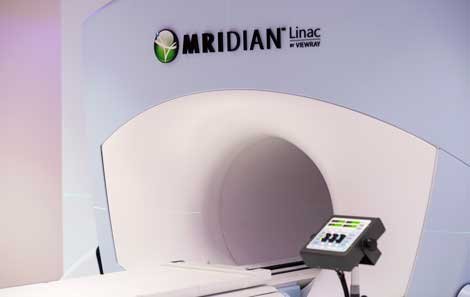
MR-linac is an MRI-guided radiation therapy system. This high-tech device means we can better target only the tumor with a high dose of radiation. For you, this means:
- Fewer treatment side effects
- Fewer trips for treatment
UVA Cancer Center is among the first 25 centers nationwide to install a MRIdian® MR-linac machine. As Virginia’s first NCI-designated comprehensive cancer center, we’ve got the expertise to bring this breakthrough treatment to you.
MR-Linac: Game Changer for Cancer Care
MRIdian is FDA-approved. In 1 innovative device, it combines 2 key features:
- Magnetic resonance imaging (MRI) so we can better target the tumor
- Linear accelerator to deliver high-dose radiation to kill cancer cells
This therapy is best for treating tumors in and around the chest or abdomen. MR-linac may be right for you if you need radiation therapy for:
Advanced Radiation Therapy
Our care team explains the advantages of MR-Linac. View transcript.
EINSLEY-MARIE JANOWSKI, MD: An MR-Linac is a combination of two different technologies. It combines an MRI imager, which allows us to see normal and disease anatomy in great detail. And a linear accelerator which allows us to produce therapeutic x-rays to treat cancer. The combination of these two technologies really allows us to do amazing things that we couldn't do before.
PAUL READ, MD: It allows us to look inside patients while we're treating them. We can see the tumor that we're treating. And the normal tissues around them.
ANDREW TAYLOR: X-rays are not very good at determining the boundaries between different soft tissues. So if you're treating in the abdomen here, trying to determine where one organ stops and the next one starts, can be very difficult.
JANOWSKI: The MR-Linac is different from a traditional linear accelerator because it allows us to see that soft tissue anatomy in great detail.
MATTHEW MISTRO: There's been a lot of advancement in order to develop the MRI Linac and as a physicist it's just very fun to think about. Normally, a linear accelerator would produce a lot of extraneous noise to cloud our imaging quality of our MRI. And the MRI would deflect and ruin the production of our therapeutic radiation. So they were able to bring together these technologies and effectively hide them from one another, so that they can work in harmony. And it is truly a beautiful piece of engineering.
JANOWSKI: What used to take us a week to plan, we can literally do in one day while the patient is on the table, adapting the treatment so that we can precisely focus on the tumor. But really miss the adjacent structures that could cause toxicity in the future.
JOAN HARRIS, RN: It is painless. They'll just very much lie still. The good news about this one is if they do breathe, it's not going to stop treatment. In the CT-based Linac machines, for some treatments, you have to hold your breath. So the patient can breathe normally throughout the procedure. They just lie still and then they'll come in and get them off the machine. It's just very loud, so they get to pick out their own music.
READ: We've never before had an opportunity to have an MRI scan of a tumor during a course of treatment on a daily basis. Some cancer treatments are five days, but some go on for 30 treatment days. And we'll have an MRI image from each day and we can see how the tumor responds.
TAYLOR: UVA is currently the only NCI-designated comprehensive cancer center in Virginia.
JANOWSKI: I think patients should consider coming to UVA for their cancer treatment. In addition to this exciting new technology, UVA has dedicated and brilliant oncologists wanting to participate in your cancer care. In addition, we will be setting up telemedicine visits for our patients, to really help you determine whether or not this MR-Linac is the best treatment for your cancer.
Advantages of Radiation Therapy With MR-Linac
MR-linac overcomes some of the limits of conventional radiation therapy. Tumors can change shape or move during treatment, especially in parts of the body that shift as you breathe and digest food.
MR-linac allows cancer experts and even patients to see the tumor in real-time during therapy. This means we can:
- Lock in and radiate the tumor when it falls into the target area
- Turn off the radiation when the tumor isn’t aligned properly
Fewer Side Effects & Trips for Treatment
An X-ray or CT scan is traditionally used to help pinpoint the location of a tumor before radiation therapy. An MRI provides a more detailed image. It can help experts tell the tumor and healthy tissue apart.
During treatment, the care team can adapt therapy to account for changes in the body. This means treatment tailored to your anatomy on the day of your treatment.
This means fewer side effects from treatment.
MRIdian offers high-dose treatment. This could mean 5 instead of 30 treatment sessions.
Amazing Things
MR-linac is a game changer for treating the most difficult cancers.
What to Expect During Treatment
MR-linac treatment is painless and lasts about 10 minutes.
You’ll need to lie still inside the MRI cylinder. You can wear earplugs or headphones to help block noise from the MRI.
But unlike during a regular MRI, you may have the option to watch a video screen. On the screen, you’ll see if the tumor is in the target zone.
Just by changing the pace of your breathing, you can help hit the target zone.
Most patients can go back to their regular routine right after treatment.
Recently Diagnosed With Prostate Cancer?
Clinical Trials Planned to Advance Cancer Care
UVA Cancer Center will help advance the use of MRIdian. Advancing cancer care happens best through clinical trials. UVA Cancer Center plans to test MR-linac’s effectiveness in treating cancers like:
- Rectal cancer
- Pancreatic cancer
- Prostate cancer
Talk to your care team to see if you may
A Care Team to Guide You
At UVA Health, you’ll have a whole team guiding you through every aspect of your treatment with MR-linac. This team includes:
- Radiation oncologists who oversee every aspect of your care. They help decide the best treatment, how much radiation you’ll need, and where to deliver it.
- Physicists and dosimetrists who plan the treatment. They make sure the right dose of radiation is delivered only to the tumor.
- Nurses who provide care and support throughout your treatment. They’ll make sure you understand any necessary safety measures.
- Radiation therapists who perform the MRI scan. They’ll position you during treatment and deliver the radiation treatment. They’ll help make your treatment as successful as possible.