High-Risk Pediatric Asthma Program
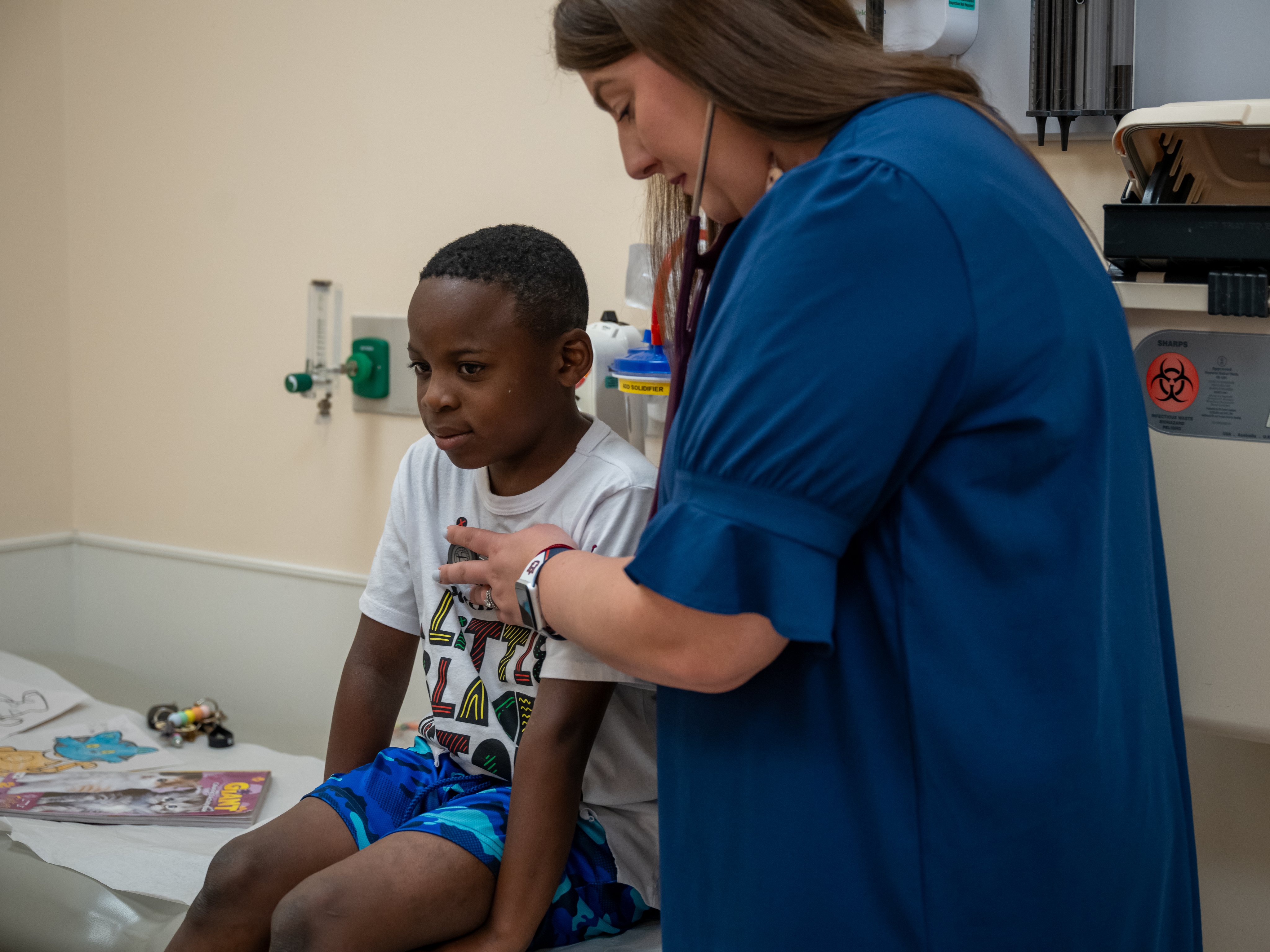
For many children with asthma, a routine treatment plan is sufficient to manage symptoms long-term. But for some, asthma can interfere with daily activities despite ongoing care.
Recurrent flare-ups, Emergency Department (ER) visits, hospitalizations, and missed school days may be signs that a child is at risk or needs advanced care.
A New Approach to Managing High-Risk Pediatric Asthma
UVA Health Children’s high-risk pediatric asthma clinic takes a multidisciplinary approach to managing pediatric asthma symptoms. By bringing together pediatric pulmonary and allergy expertise, program founders and co-directors Brittany L. Wall, MD, and Samantha C. Minnicozzi, MD, seek to provide closer supervision and better outcomes for children with high-risk asthma.
Established in January 2026, the pediatric high-risk asthma clinic is designed to identify children at increased risk for poor outcomes. “This program is a subset of our overall asthma program,” explains Wall. “It helps us keep a closer eye on patients and manage them better in a multidisciplinary clinic setting.”
Beyond Routine Asthma Management
UVA Health Children’s is nationally ranked and offers specialized care and evaluation for infants, children, and adolescents with respiratory conditions, including severe or difficult-to-control asthma. The program was created for children whose asthma remains poorly controlled or who have experienced significant asthma-related complications.
“Our high-risk asthma program is for patients who have been admitted to the ICU, have had a history of repeated hospital admissions for their asthma, or repeated Emergency Department visits or admissions for their asthma,” explains Wall.
As a general guideline, she recommends referring children who have had at least two hospital admissions or three ER visits for asthma within a year.
Who Can Benefit From Multidisciplinary Care?
At the high-risk clinic, pulmonary and allergy specialists review cases collaboratively. “We meet with every patient together, and we look at every case together,” says Wall. This allows the team to consider respiratory function, allergic disease, environmental triggers, comorbid conditions, and other factors that may influence symptoms.
The team does more than adjust asthma medications. They evaluate the whole patient and work with families to develop an individualized treatment plan for each child.
For Wall, caring for children with severe asthma is personal. “I had severe asthma as a kid. I had to travel out of state to see a pulmonologist because there were none in my state or the next state. I was lucky. I had a great pediatrician and parents who did everything they could to keep me healthy. But I was still in and out of the hospital a lot. So, I understand what these kids are going through. I'm very passionate about this.”
And their approach is working. “Because of our multidisciplinary care, we have seen a decline in hospital admissions and steroid usage in our patients with severe asthma. This approach is leading to great outcomes.”
Additional Evaluation, Treatment, & Support
Specialty evaluation can help diagnose why a child's asthma remains uncontrolled and whether additional interventions can help. Depending on a patient's needs, the team at UVA Health Children’s can provide:
Allergy testing and immunologic evaluation
Detailed lung-function assessment
Evaluation for triggers and comorbid conditions
Spirometry and other pulmonary testing
UVA Health also offers advanced imaging and bronchoscopy to assess lung function and airway inflammation.
At the high-risk clinic, treatment may include optimizing inhaled therapies, biologic therapies, and allergy shots as well as managing associated conditions such as eczema. “We do it all,” explains Wall.
The clinic’s goal is not to replace a child's primary care. Rather, UVA Health Children’s partners with referring healthcare providers to offer specialty expertise, diagnostics, and follow-up care. Referring providers receive detailed notes and can stay connected with their patients through EpicCare.
When & How to Refer
The high-risk asthma program is expanding. “Right now, we have about 60 to 70 patients in our cohort. And we are growing rapidly,” says Wall.
Consider referring a patient for evaluation when a child's asthma remains poorly controlled despite treatment, particularly when there are recurrent exacerbations, ER visits, or hospitalizations.
Wall and Minnicozzi review each referral to determine whether the child would benefit from care at the high-risk clinic. “We're always accepting new patients,” says Wall.
To refer a patient, providers can call 434.924.KIDS (5437) for a same-day consult, Monday through Friday, 8 a.m. to 5 p.m., or use UVA Health Children’s online referral form.
UVA Health also offers virtual appointments and provider consultations when appropriate.
Article Topics